
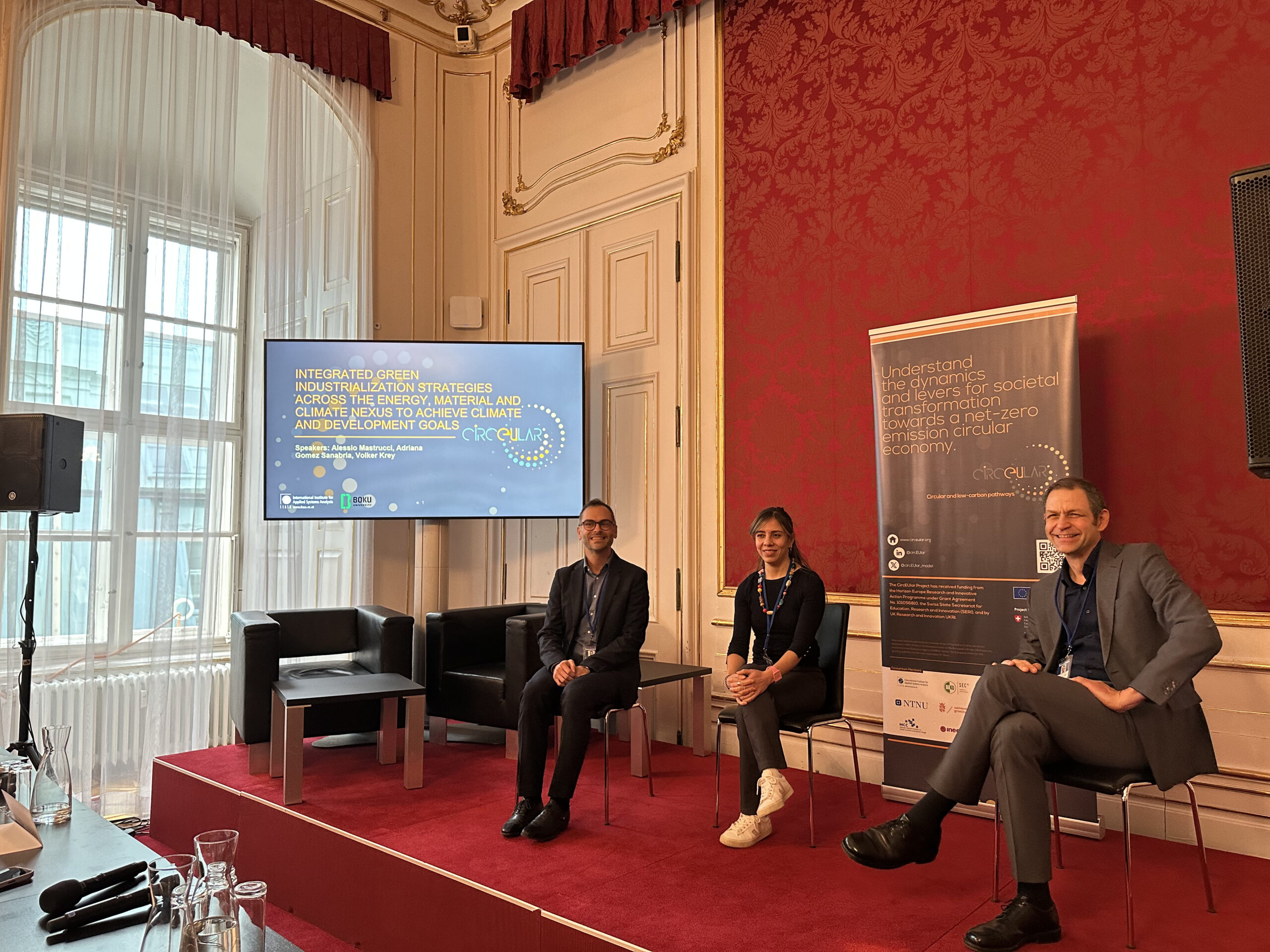
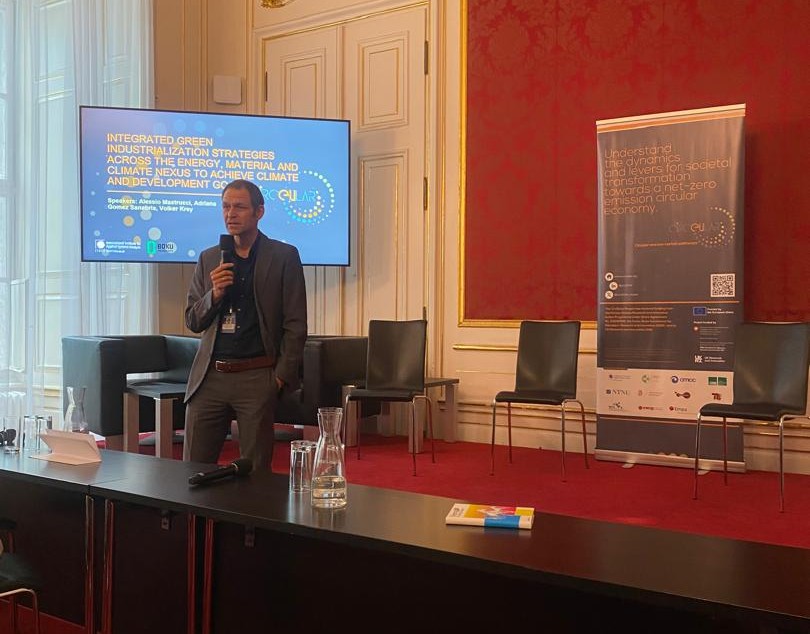
Within the framework of the International Vienna Energy and Climate Forum (IVECF) 2026, CircEUlar researchers Volker Krey, Alessio Mastrucci, Adriana Gomez Sanabria, and Dominik Wiedenhofer convened a high-level Deep Dive session titled “Integrated green industrialisation strategies across the energy, material and climate nexus to achieve climate and development goals” on 10 April. The session brought together representatives from policy, industry, finance, international organisations, and research.
Discussions highlighted that, as countries move closer to net-zero emissions, addressing emissions embedded in infrastructure and products becomes increasingly important. The researchers presented how alternative provisioning systems and innovative business models can create opportunities for green industrial growth while strengthening system resilience and resource security. Opportunities and challenges related to building up new infrastructure in the Global South to enable economic development were of significant interest to the audience and therefore taken up in a very active discussion.
Efforts to tackle climate change have long focused on reducing operational emissions during the use phase of goods and services – from driving more efficient cars to improving the energy performance of buildings. While these efforts have delivered important gains, they largely overlook so-called embodied emissions that are already “locked in” long before the product is ever used, embedded in infrastructure, buildings, vehicles, and other goods. This imbalance becomes increasingly important as systems move closer to net-zero greenhouse gas (GHG) emissions – the point at which operational emissions are largely eliminated and embodied emissions begin to dominate. Addressing these emissions requires more than incremental efficiency improvements and calls for a broader reconsideration of how goods and services are provided.
Alternative provisioning systems: a missing piece in the transition to net zero
Improving the use of existing infrastructures and goods, and rethinking how demand is met, can significantly reduce both embodied and operational emissions. In this context, reconfiguring provisioning systems offers an important entry point for integrating energy, climate, and industrial policies, helping to catalyse progress towards climate and development goals.
Evidence from sectoral case studies – covering mobility, buildings, and household appliances – shows how alternative provisioning systems of goods and services can reduce energy and material demand, lower lifecycle emissions, and support decent living standards and wellbeing. At the same time, these approaches open up new green growth opportunities for industry through innovative business models and activities.
Mobility
Global mobility infrastructure comprising roads, tunnels, bridges, railways, and subways is expected to grow substantially in the coming decades, especially in the Global South. Already existing mobility infrastructure amounts to roughly one third of global societal material stocks and its further expansion may require a substantial share of the remaining global carbon budget for limiting global warming to 1.5°C above pre-industrial levels. We analysed seven demand- and four supply-side material and emission-focused strategies to mitigate resource use and embodied CO2 emissions required for mobility infrastructure.
Our analysis demonstrates that without demand-reducing measures, infrastructure stocks could grow by a factor of two to three by 2060, with cumulative embodied emissions reaching between 10 and 20 GtCO2. Mobility reductions, focusing on the Global North, combined with improved recycling and decarbonisation of energy and industry could reduce embodied emissions by almost two thirds, while providing sufficient mobility infrastructure globally. This would help to offset increases in emissions from public transport infrastructure expansion required to reduce operational emissions.
Buildings
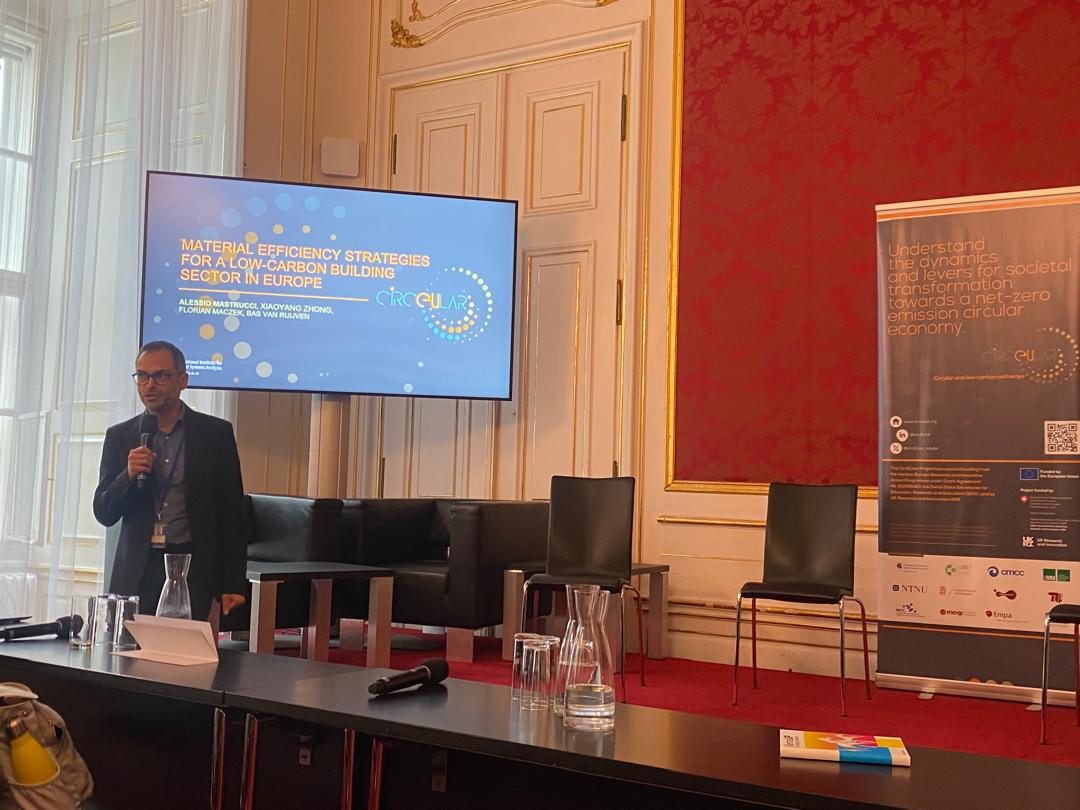
The built environment accounts for about 50% of all extracted material in the European Union (EU). In buildings, more than a quarter of the sector’s carbon emissions are embodied. Reducing material demand, alongside operational energy demand, is critical to mitigate sectoral GHG emissions and contribute to reaching net-zero emission targets. Material efficiency strategies have significant potential to reduce the GHG emissions of buildings. Current studies, however, mostly focus on the reduction of operational energy and often overlook embodied emissions and the potential of circularity strategies at regional and global scales. Accounting for demand-side material efficiency strategies and their implications on material and energy demands is key to exploring more comprehensive pathways for the decarbonisation of the buildings sector.
We explored the potential to reduce the GHG emissions of the European residential sector by implementing a set of material efficiency strategies in combination with broader climate mitigation policies. Our results show that three key demand-side strategies for buildings, namely floorspace reduction, switch to wood-based construction, and lifetime extension, can reduce material demand by up to 65% compared to a business-as-usual scenario by 2050. These strategies can therefore contribute to major reductions in embodied GHG emissions from building construction and increase the feasibility of decarbonisation pathways.
Household applications
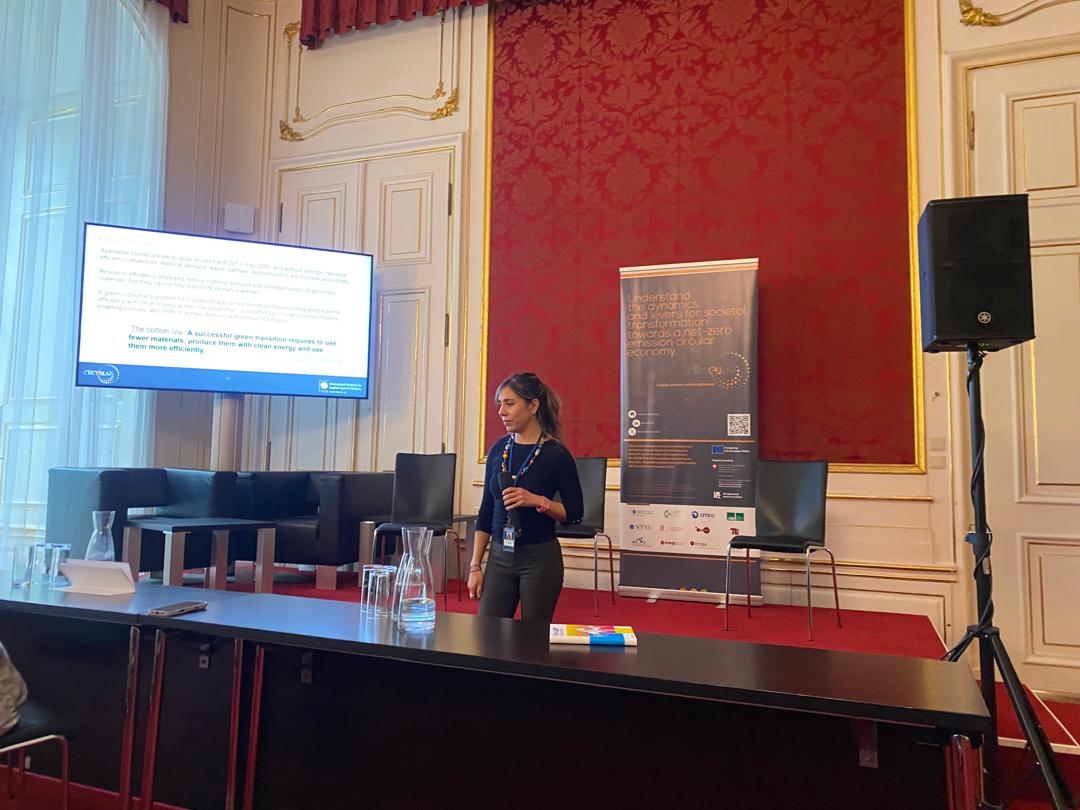
Electrical appliances are essential to modern life, but they are also responsible for significant energy and material use, emissions, and electronic waste, accelerated by electrification and digitalisation trends. Current assessments often lack lifecycle coverage and sufficient granularity to fully capture environmental impacts or evaluate mitigation options. A case study of washing machines in Europe showed continued growth in stock, energy demand, material use, and emissions to 2050.
A combination of strategies that improve utilisation of appliances such as sharing (e.g., shared washing machines) or improved design for repairability and maintenance and recycling, can cut embodied emissions by about 70% and total lifecycle emissions by about 30%. Combining these strategies with better efficiency and cleaner electricity can reduce emissions by about 90%, leaving materials and construction as the primary remaining sources. In regions already low in carbon emissions, such as Northern Europe, most emissions now come from materials and construction, making reuse and recycling especially important for further reducing emissions.
About the International Vienna Energy and Climate Forum (IVECF)
The International Vienna Energy and Climate Forum, previously known as the Vienna Energy Forum, is a solutions platform to accelerate low-emission, climate-resilient development around the world and facilitate multi-sectoral, multi-stakeholder and inter-disciplinary dialogue to advance sustainable energy development while promoting inclusiveness and the empowerment of women and youth. The IVECF 2026 was held on 9/10 April 2026 in the Imperial Palace of Vienna and attracted about 1,800 participants from across the globe. Initiated in 2008, the Forum is co-organised by the United Nations Industrial Development Organization (UNIDO), the Government of Austria, and the International Institute for Applied Systems Analysis (IIASA) – Coordinator of the CircEUlar project.