
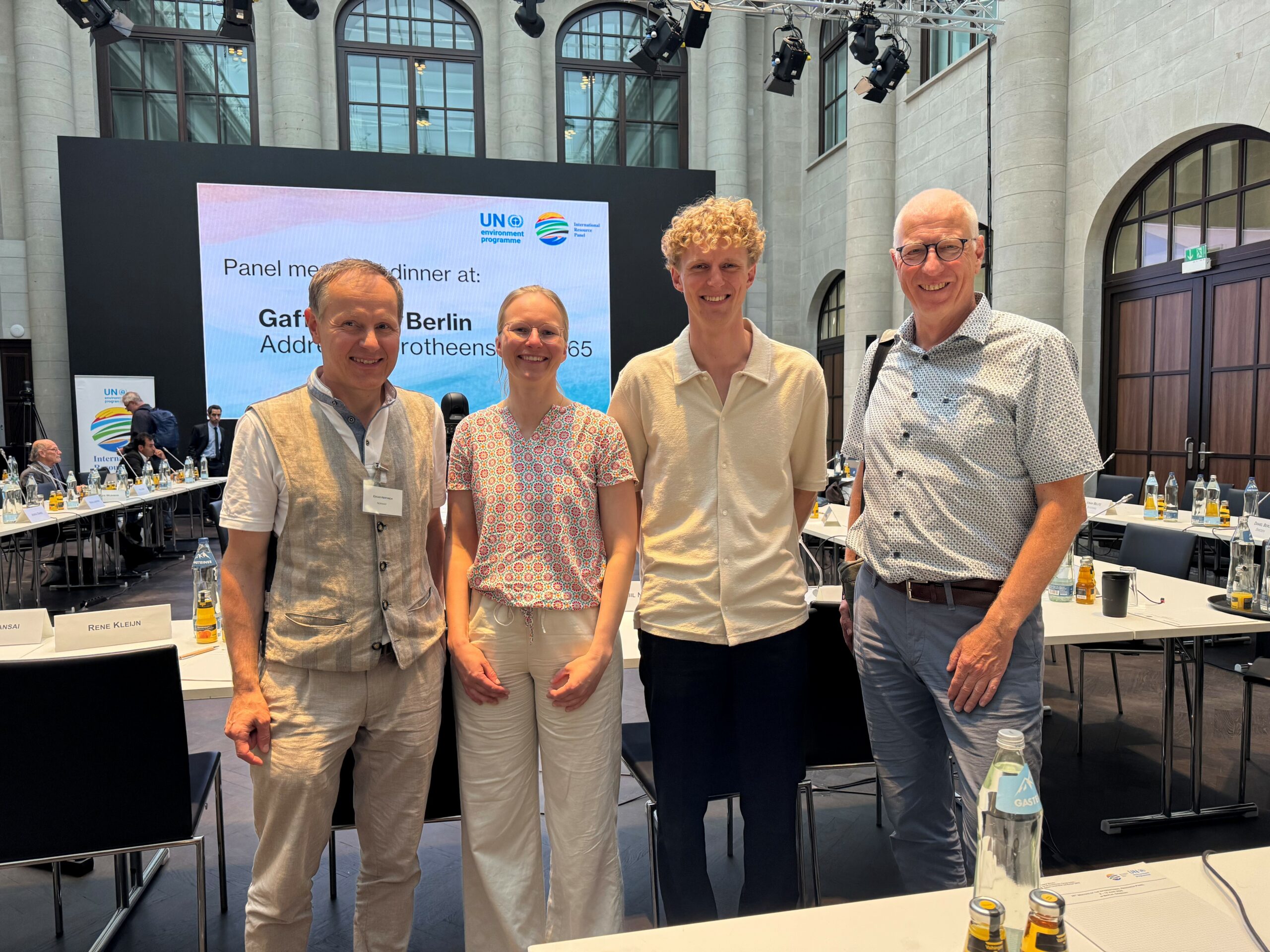
As part of the 35th Meeting of the International Resource Panel (IRP), held in Berlin from 8-12 June 2026, CircEUlar and its sister project CIRCOMOD contributed to a dedicated side event for IRP Steering Committee members focused on the role of circular economy measures in greenhouse gas emission mitigation.
The CircEUlar and CIRCOMOD projects, funded under Horizon Europe, introduce new approaches to representing material efficiency and circular economy measures in emission scenario models, including the MESSAGEix and IMAGE models developed at International Institute for Applied Systems Analysis (IIASA) and PBL Netherlands Environmental Assessment Agency.
On 8 June, both projects presented their latest findings. The session opened with Steve Hatfield-Dodds of EY Parthenon from Australia introducing the scenario modelling plan for the forthcoming Global Resources Outlook 2028, the flagship report of the IRP.
A key contribution from CircEUlar focused on the development of datasets and tools for representing the European building stock. CircEUlar researcher Florian Nachtigall (Potsdam Institute for Climate Impact Research (PIK)) presented work on mapping individual buildings across Europe, highlighting the newly released EUBUCCO v0.2 dataset and its role in improving models of material use, building lifetimes, and circular strategies in the built environment.
Additional presentations from CIRCOMOD covered circular economy scenarios developed as part of the project, presented by Frederike Arp (Utrecht University), as well as the project’s work on machinery and equipment, presented by Edgar Hertwich (Norwegian University of Science and Technology (NTNU) and International Institute for Applied Systems Analysis (IIASA)).
The session was chaired by Hans Bruyninckx, former director of the European Environment Agency (EEA). The presentations stimulated a lively discussion, and Bruyninckx concluded that this work would mark, for the Panel, the beginning of a broader conversation on modelling technical materials in the economy.
The discussion was well received by the IRP. Members called for this to be the start of a continued conversation on strengthening both the empirical foundations and the modelling of the circular economy, as well as its contribution to reducing material use, climate change, and other environmental impacts.
Notably, the International Resource Panel (IRP) and its report on Resource Efficiency and Climate Change were instrumental in shaping the Horizon Europe call that funded the two projects.