
The integrated methodological framework for modelling circularity in mobility and building and household services has been successfully applied to the cities of Porto and Berlin, two distinct geographical and structural urban contexts. This aimed at deepening the understanding of how the physical urban environment, socio-economic and behavioral drivers influence energy and material needs, both individually and in combination, through a spatially-explicit and data-driven approach – the so-called Spatial Urban Energy and Materials Model (SUE2M).
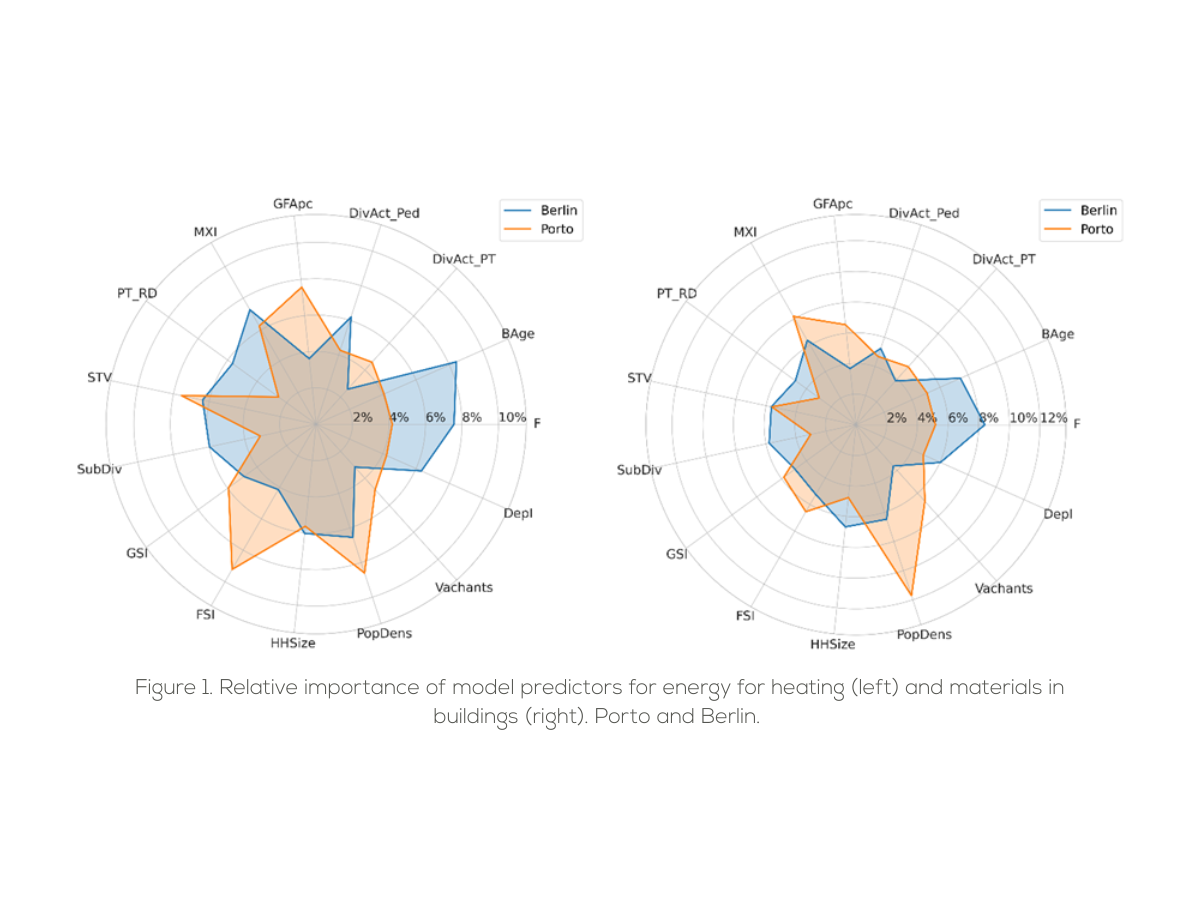
Two consistent urban models have been developed for the two cities, and several application approaches have been adopted to extract information: i) model performance metrics, ii) feature importance analysis, iii) urban development scenarios, and iv) sensitivity analysis. The results show that although variable importance differs across cities, their respective behavior, i.e. the direction of their influence is generally consistent. All in all, urban form features, especially built-up (F, FSI) and population density (PopDens), emerge as key drivers across the two cities, alongside building age (BAge) and type, land-use diversity (MXI), and household size (HHSize) or gross floor area per capita (GFApc, Figure 1).
Nevertheless, the existence of differences across the two cities was anticipated, as these consist of two very different urban realities with distinct development patterns. For instance, in the case of energy for heating, building age and the number of floors (F) play an important role in Berlin, while in Porto GFApc, FSI and population density evidence a significantly larger relative weight.
This can be to a large extent explained by the fact that the renovation dynamics experienced in Porto in the last decade may be contributing to detaching building age from energy performance, whose strong correlation is still visible in Berlin. In addition, despite it is clear that density also affects energy needs, it is also observed that different aspects of density impact differently. For example, historically, Porto has had restrictions with building in height (the local municipal masterplan imposes upper height limits in several areas of the city, particularly those with consolidated urban tissues). For this reason, it seems natural that the number of floors does not show a very strong influence (in relation to Berlin), but the FSI instead seems to capture well the effect of built-up density.
Furthermore, in what regards to materials in buildings, again density both population and built-up in Porto and Berlin, respectively represents an important driver. Still, the choice of location of urban interventions (e.g. densification) proves to be key in determining overall urban performance, highlighting the role of urban planning in creating more efficient and sustainable urban settings.
By INEGI