
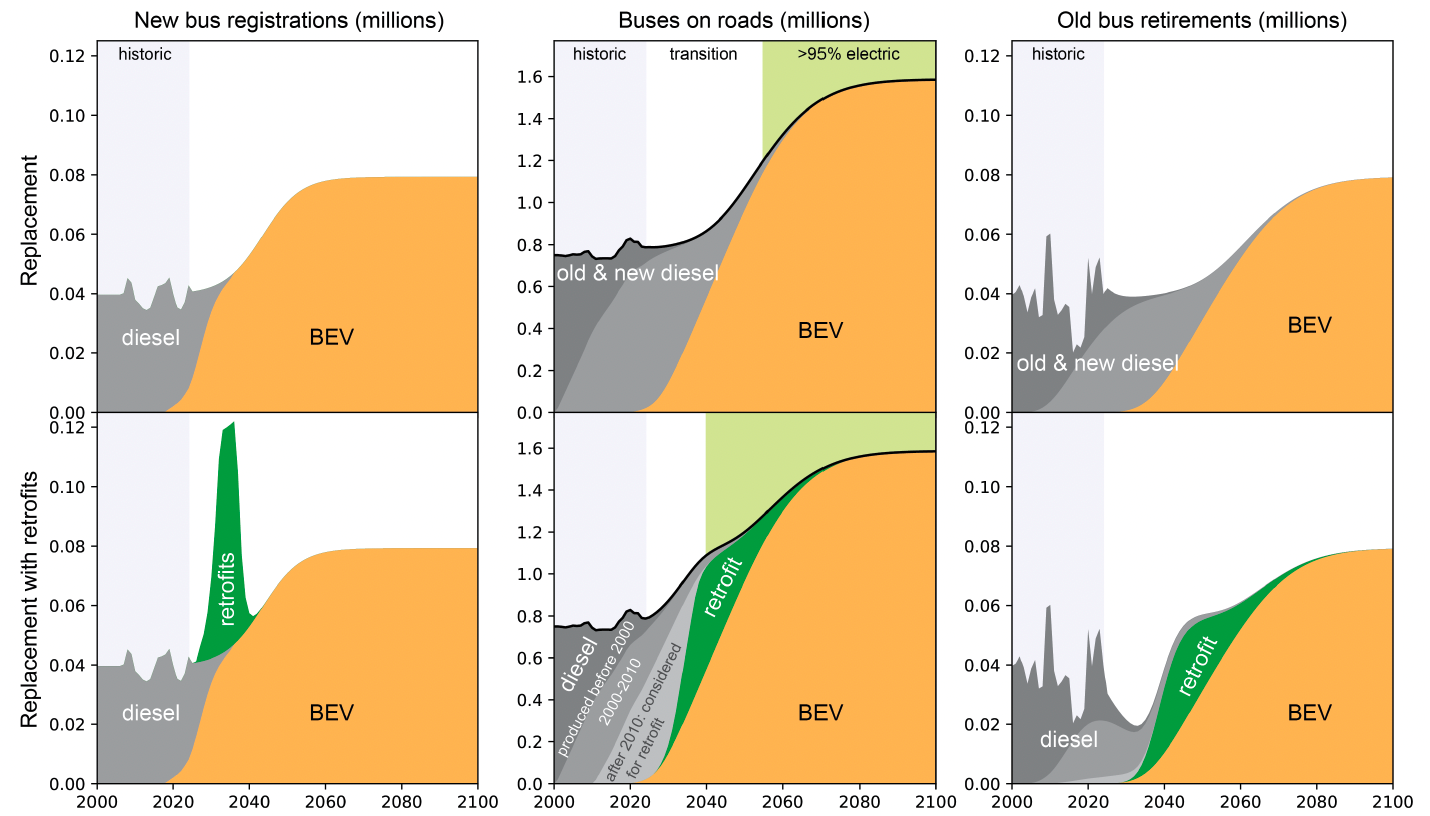
Electrification of terrestrial mobility is a cornerstone of the energy transition and mature technological battery-electric vehicles are available in all vehicle categories. Replacing the vehicles currently on the road, the majority of which is still fossil powered, will only be completed after 2050. Reducing the demand for private cars depends on increasing the attractiveness of public transport. But electrifying public mobility is a challenge in itself.
For example, a simple replacement strategy of diesel buses currently on the road in EU27+4 would take at least until 2057 even if the last diesel bus would be sold in 2035. Faster electrification will require either to shorten the lifetime of existing buses—which would increase investment costs significantly and is counter to the narrative of a circular economy—or retrofitting of existing diesel buses with electric drive trains.
Many companies and start-ups pioneer the concept of e-retrofitting for vehicles from motorbikes to mining trucks. So far, they are still niche players on the vehicle market, yet the e-retrofitting strategy has the potential to accelerate the electrification of road vehicles significantly. In the case of the European bus fleet, e-retrofitting can accelerate electrification by 15 years, saving emissions, raw materials, and costs at the same time as creating jobs and opportunities for industry.
When expanding the bus fleet to increase public mobility service, e-retrofitting can help to increase the number of busses on European roads faster. Overall, around 300 million tons of CO2e can be saved directly with this measure, which is comparable to the annual emissions of Spain. The strategy of e-retrofitting busses and its system-wide implications are described in detail in the new paper in Environmental Research: Infrastructure and Sustainability.