
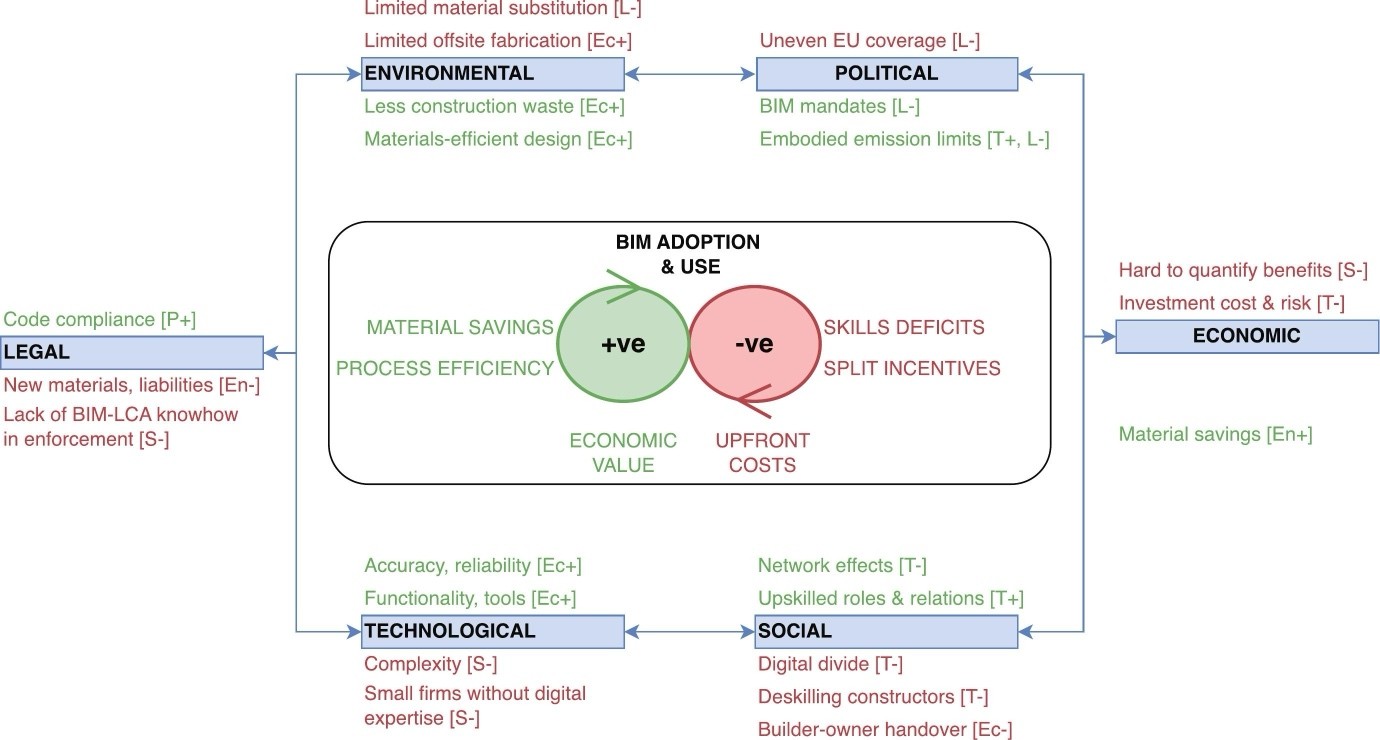
Figure 1: Main drivers and barriers of BIM adoption and use along the 6 dimensions of the PESTLE framework. (Burgess et al., 2026)
Building Information Modelling (BIM) is an approach that uses digital building models throughout the entire lifecycle of a built facility, ranging from design and construction and the long phase of operation (Borrmann et al., 2018). It could improve information flow between stakeholders at different stages and potentially enable the circular economy, although this is still emerging.
In the recent published article by CircEUlar team (Burgess et al., 2026), the barriers to BIM adoption that impedes its more widespread use are discussed. It highlights that digitalisation could be one of the enablers, but its benefit does not automatically materialise as similar challenges exist in other digital solution. There are still gaps that need to be tackled.
The combined insight from 41 expert interviews with architects, consultants and constructors across 11 European countries indicates that BIM is primarily used to streamline construction process rather than improve resource efficiency. The study identifies challenges with interoperability issues, split incentives and value chain fragmentation, and weak economic incentive, particularly for small firms. BIM suffers from low penetration among smaller architects and small- and medium-sized contractors, and even more so for moderately advanced functions such as clash detection and Bills of Materials, with a 5% usage level even among BIM adopters. Penetration rises to about 32% of users in larger firms. The main drivers (green) and barriers (red) of BIM adoption and use are summarised across 6 dimensions, as illustrated in the Figure 1.
The push for green certification standards and whole-building lifecycle emission regulations for buildings mandated by the EU is anticipated to foster BIM adoption. Four Northern European countries (Denmark, the Netherlands, Sweden, and France) have already enacted similar emission limits, potentially paving the way for more widespread adoption. The authors suggest that 21-31% of embodied emissions could be reduced after 10 years through material savings enabled by BIM in new buildings under the policy inception. BIM could become a key digital enabler of circular economy principles if barriers to adoption are addressed through policy, skills development, and better incentives.
Reference:
Burgess, M., Wilson, C., & Fan, Y.V. (2026). Adoption drivers and barriers of Building Information Modelling (BIM) in Europe. Energy and Buildings, 116953.
Borrmann, A., König, M., Koch, C., & Beetz, J. (2018). Building information modeling: why? What? How?. In Building information modeling: Technology foundations and industry practice (pp. 1-24). Cham: Springer International Publishing.