
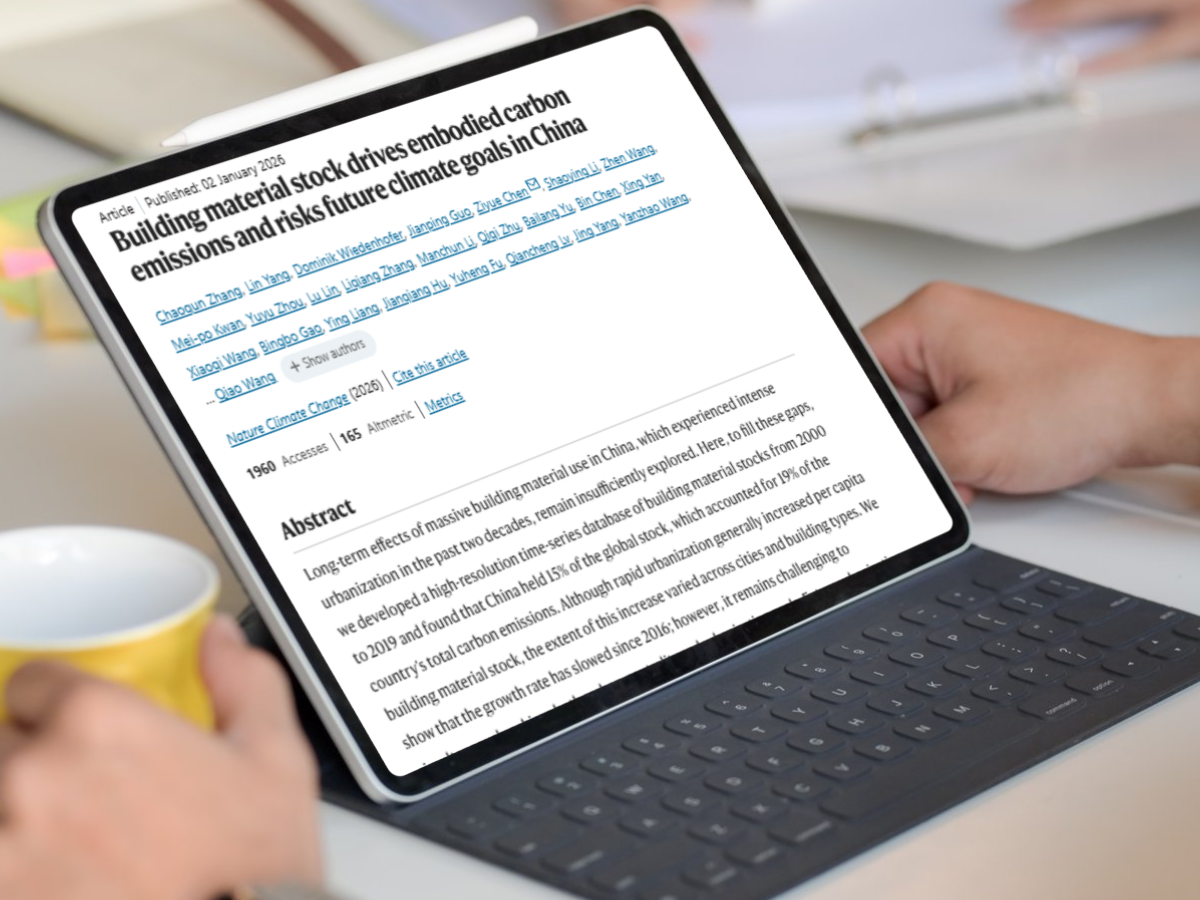
China’s unprecedented rapid urbanisation has significant long-term impacts on the countries and global climate goals, particularly due to the enormous resource consumption required. An international study involving BOKU University now reveals how unevenly building growth has occurred over the past 20 years, and how this contributes to climate-damaging emissions.
The study shows that China’s buildings and the amount of construction materials used have almost doubled since 2000. Approximately 15% of all materials used worldwide are found in China’s buildings. The production of these materials and the construction sector handle 19% of China’s total carbon emissions. Although the growth in building material stocks has slowed since 2016, achieving the goals of carbon neutrality and further urbanisation at the same time is still a major challenge.
High-resolution building data as a new basis for resource research
For the study, highly detailed maps for all of China were created with a resolution of 30×30 meters and covering all buildings and materials they hold for the period from 2000 to 2020. The data covers over 200 million buildings and combines satellite-based Earth Observation, crowd-sourced geodata, field research, and machine learning. This made it possible to identify materials, building types and heights, as well as changes over time, accurately and independently of official statistics. The research results were recently published in the renowned journal Nature Climate Change.
Dominik Wiedenhofer, from the CircEUlar partner the Institute of Social Ecology at BOKU University, was centrally involved in fundamental methodological developments and supported the Chinese research team with his expertise, playing a prominent role in advancing the evaluation of the results. Compared to similar studies conducted by Wiedenhofer on Austria and internationally, the findings suggest that, on a per-capita basis, approximately twice as many resources are used in European buildings as in China, while wealthy cities in China use very comparable amounts.
Urgent need for action in policy and spatial planning
“In both China and the EU, targeted political and spatial planning measures are urgently needed to ensure quality of life and achieve climate targets,” said Wiedenhofer. “This includes, in particular, the regional implementation of an ambitious circular economy, i.e., renovation and refurbishment before demolition and new construction, forward-looking urban and infrastructure planning that puts an end to urban sprawl, and strategic preparation for the recycling of materials from future building demolition.”