
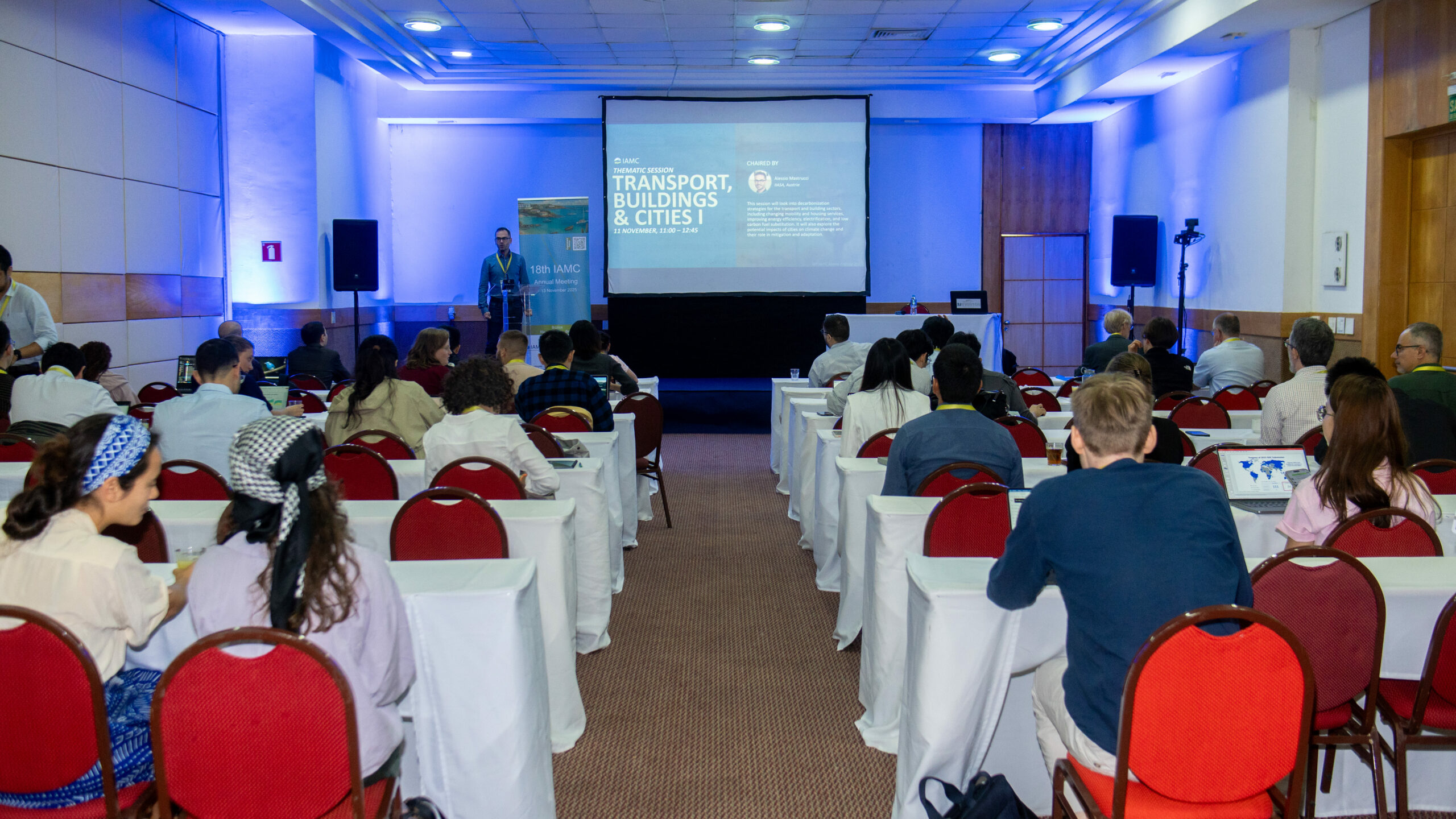
CircEUlar researchers Florian Maczek and Alessio Mastrucci participated in the 18th Integrated Assessment Modeling Consortium (IAMC) Annual Meeting, held from 11-13 November 2025 in the city of Armação dos Búzios, state of Rio de Janeiro, Brazil. They presented research results from the CircEUlar project and participated in a meeting to better represent material cycles in Integrated Assessment Models (IAMs).
Florian Maczek presented his recent work in the INDUSTRY session that was focused on two overarching themes, (i) exploration of pathways under different socio-economic futures, and (ii) assessments of circular economy strategies in the industry sector. Besides the presented research from the CircEUlar project by Florian Maczek, the session also benefited from presentations of the sister project CIRCOMOD held by Marianne Zanon Zotin and Leticia Magalar.
In the TRANSPORT, BUILDINGS and CITIES session, Alessio Mastrucci introduced analysis that shows that shifting the current construction practice to mineral-based or wood-based solutions can enable significant carbon storage and removal potential of up to 1.8 and 0.5 Gt CO2/yr by 2050, respectively. While the carbon removal and storage potentials are higher for the mineral-based solutions, the lower embodied carbon associated with wood-based solutions contributes to lower net embodied emissions.
Florian Maczek and Alessio Mastrucci also attended the Scientific Working Group on Data Protocols and Management. As respective co-leads of the industry and buildings subgroups, they reported back on the progress of the sector-specific data template development. The annual meeting was also used to coordinate plans across the subgroups and agree on common next steps in person.
Below are the details of the researchers’ contributions.
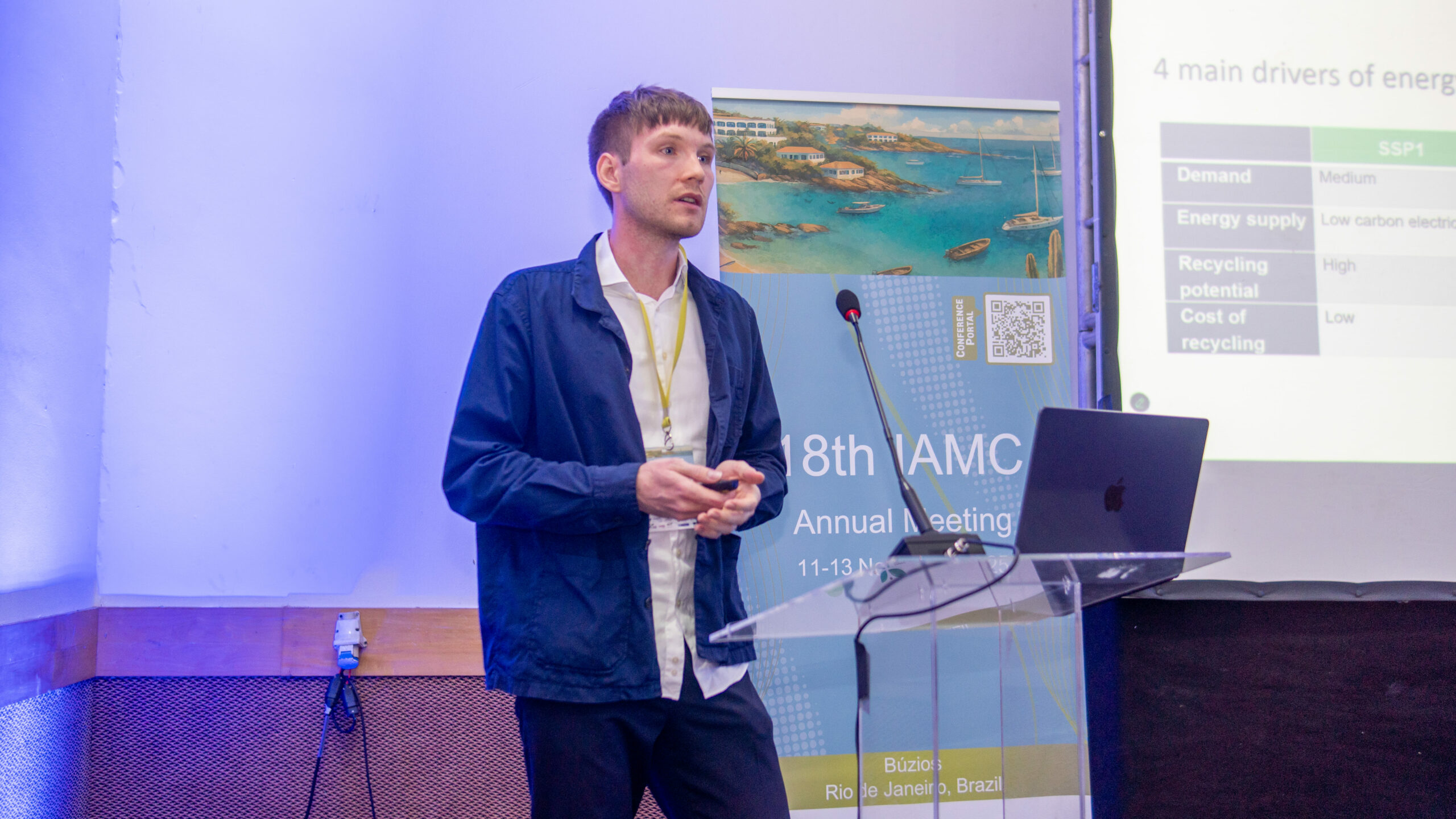
Florian Maczek, Yiyi Ju, & Volker Krey: Exploring long term futures of the industry sector – quantifications of SSP narratives with MESSAGEix-Materials (Session INDUSTRY – 1)
The industrial sector as a whole has received little attention in the SSP literature. Since industry representation of IAMs has improved recently, detailed modeling of the sector including demand side mitigation requires an advancement of the established Shared Socio-economic Pathways (SSP) scenario framework which is widely used in climate-related research. In the presentation, Florian showed a first set of industry-specific narratives with detailed parametric assumptions. The analysis focuses on the energy- and emission intensive industry sectors and explores a wide range of possible futures for the supply, demand and trade of bulk materials. For the quantification, the detailed bottom-up industry model MESSAGEix-Materials is employed. The model is fully embedded in the most recent MESSAGEix-GLOBIOM-GAINS IAM, driven by the latest SSP 3.1 projections developed in the ScenarioMIP project. The assessment shows the impact of individual SSP narratives on the future energy and emission implications for the industry sector. The results show that the direct impact of industrial activity aligns with the original SSP energy system narratives. High carbon intensity and commodity demands are the major determinants of future challenges to mitigate industry emissions.
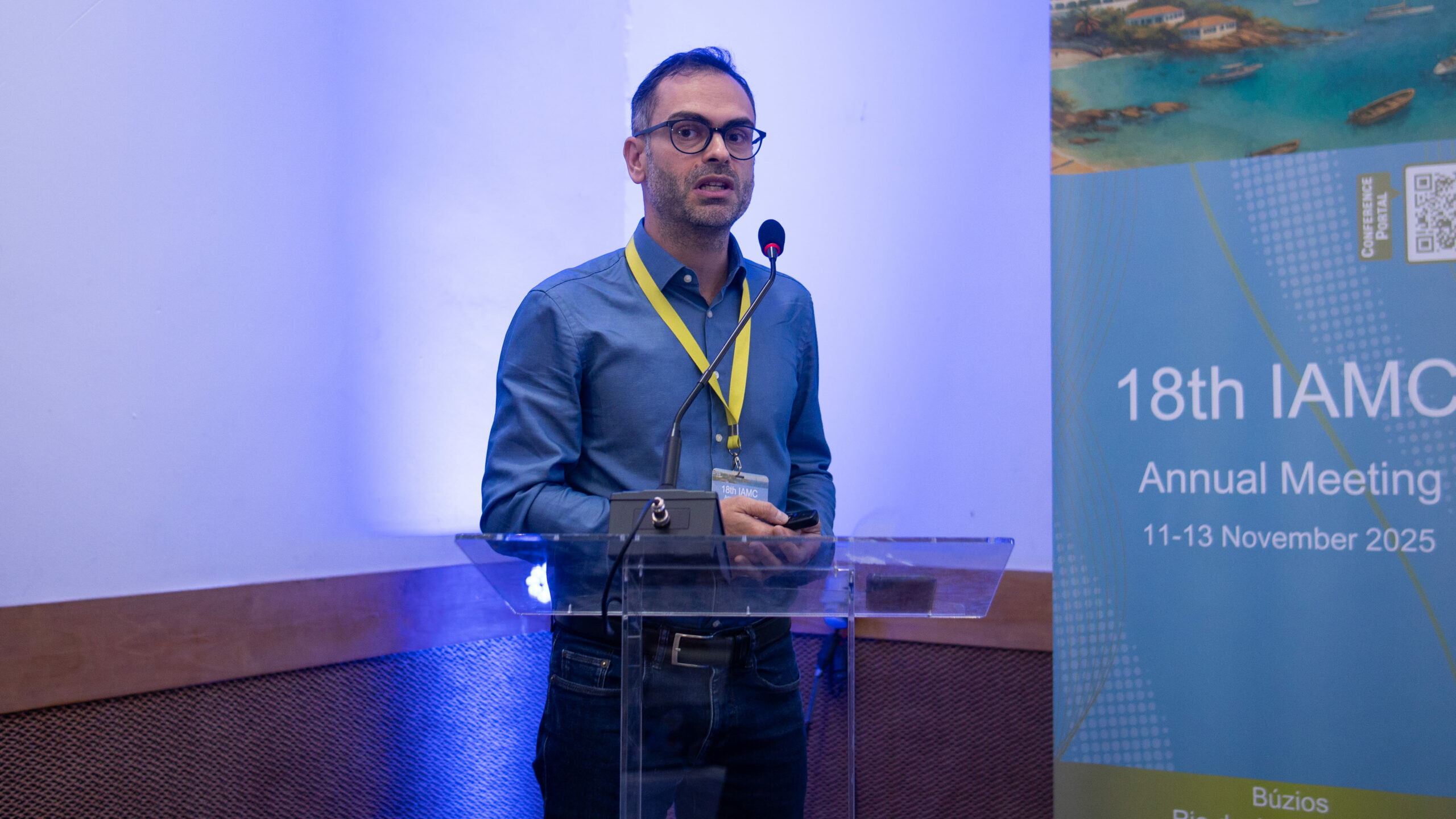
Alessio Mastrucci et al.: Exploring carbon dioxide removal and storage potential in global building scenarios (Session TRANSPORT, BUILDINGS and CITIES – 1)
The global buildings sector is responsible for enormous material demand associated with high greenhouse gas emissions. Beyond emission reductions, using bio-based and mineral-based materials for long term carbon storage in buildings has been proposed as a solution towards climate policy targets. Current global building scenarios are, however, limited in accounting for carbon removal and storage and their interplay with other sectoral and cross-sectoral mitigation policies. Here, we assess the carbon reduction, removal and storage potential of the global building sector in a comprehensive set of scenarios combining wood-based and mineral-based material solutions, different levels of climate policies, and circularity and sufficiency measures. We use a detailed building sector model combined with life cycle assessment and integrated assessment modelling to assess the interplay between different demand- and supply-side policies over the life cycle of global buildings.
In a decarbonization scenario, combining circularity and sufficiency strategies, which decreases material demand and embodied emissions, with removal and storage solutions drives the largest reduction in cumulative net embodied emissions, up to 39% with mineral-based solutions and 47% with wood-based solutions compared to a reference scenario. These results contribute to providing a better understanding of the potential of carbon removal and storage in buildings and trade-offs with embodied emissions that are critical for supporting climate change mitigation policies.